7 min read
How to Outfit a Fishing Boat: Motor, Sonar, Electrics
Order of investment, thrust and Ah ranges, screen sizes, night-light rules and beginner mistakes. Three builds: starter, sensible, full trolling.
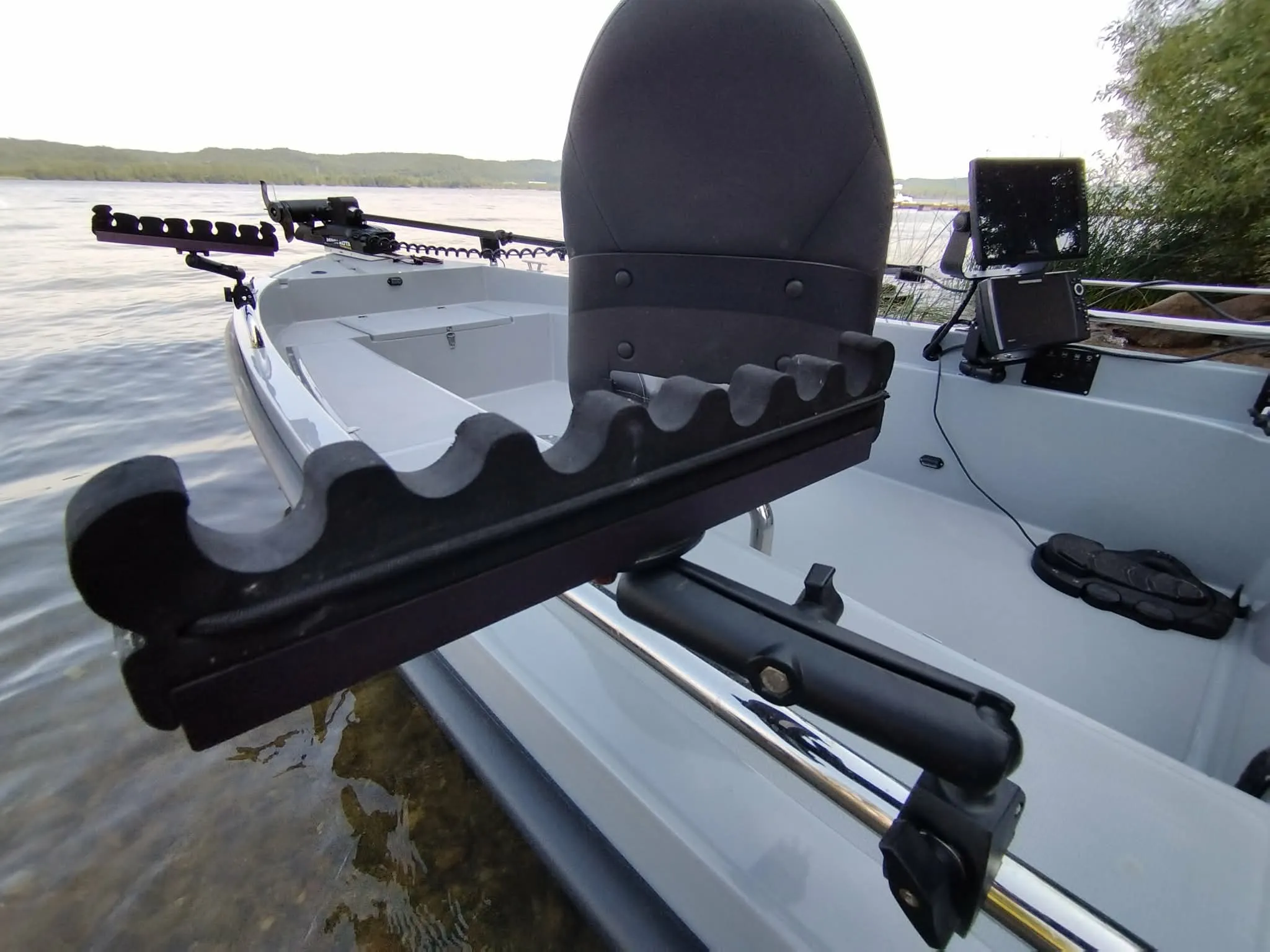
In short: outfit in this order — 1) outboard, 2) electrical system with battery and main fuse, 3) fish finder, 4) bow-mount trolling motor, 5) seats, LED and bilge pump. Electrics come before the sonar and trolling motor because both depend on them, and adding cables to a finished deck costs more than laying them once during the build. For a 4.1–4.5 m boat like a Hawala, a 55–80 lb trolling motor, a 100 Ah LiFePO4 battery and a 7-inch fish finder are enough — the rest is comfort.
Which outboard first?
One that sits within the maximum power on the boat’s CE plate, ideally in the upper half of that range. A stronger motor is not about speed: it runs at lower revs, burns less and holds a 2–4 km/h trolling pace without hunting. On lakes where combustion engines are banned, an electric outboard (3–6 kW, roughly 6–10 hp equivalent) with its own high-voltage battery takes over.
Rule: propulsion first, toys later. A boat without a sonar still fishes; a boat without a motor stays at the jetty.
What electrics and battery does a fishing boat need?
Two separate circuits: one for the trolling motor, one for electronics and lighting. Each has its own battery, its own main fuse and a switch panel with a fuse per device. The main fuse sits at the battery (ABYC allows at most 7 in / 18 cm from the terminal). It protects the cable, not the device, so you size it to the cable, not to the fish finder.
Cables are thicker than people expect. A 7-inch sonar draws 1–2 A and is happy on 2.5 mm². A 55 lb trolling motor on 12 V draws up to ~50 A: for a 3 m run you need 16 mm² (6 AWG), for 5 m already 25 mm² (4 AWG) to keep voltage drop under 3 %. Thin cable heats up and the motor loses thrust.
Battery: a 100 Ah AGM gives you about 50 Ah in practice (deeper discharge cuts life to a few hundred cycles) and weighs 28–30 kg. A 100 Ah LiFePO4 delivers 80–90 Ah, lasts thousands of cycles and weighs about 12 kg — on the bow of a 4.5 m boat you feel those 16 kg. A day of trolling with a 55 lb motor at mid power (15–25 A, 5–6 h with breaks) is 60–80 Ah. One 100 Ah LiFePO4 covers it; one 100 Ah AGM does not. LiFePO4 needs a charger with the right profile.
Which fish finder for a 4.5 m boat?
Seven inches is the sensible middle: map and sonar side by side, and the screen does not block the deck. Five inches (Garmin Striker Vivid 5cv, Lowrance Hook Reveal 5, Humminbird Helix 5) is enough to start — CHIRP, downscan, often no charts. Seven (Garmin Echomap UHD2 7, Lowrance Elite FS 7, Humminbird Helix 7 MSI) brings charts, side imaging and networking. Nine to ten inches only makes sense with a second display at the bow and live sonar (Garmin LiveScope, Lowrance ActiveTarget 2, Humminbird MEGA Live), which needs its own black box and usually mounts on the trolling-motor shaft.
A transom-mount transducer is the standard at this size: edge 3 mm below the hull, parallel to the waterline, at least 7–8 cm from the propeller and on the side where the blades sweep down (starboard for a standard right-hand prop). Keep clear of strakes, drains and rivets — each makes air bubbles, and bubbles mean a lost bottom at speed. An in-hull transducer (glued inside the hull) is cleaner and has nothing to rip off at the slipway, but needs solid laminate without core — the builder knows where that is.
Which trolling motor for a 4.5 m boat?
Manufacturers’ rule: about 2 lb of thrust per 100 lb (45 kg) of boat with motor, fuel, batteries, people and gear. For a loaded 4.5 m boat that is a 30 lb minimum — but the minimum does not hold position in a breeze on a big lake. In practice, 55 lb at 12 V is the floor, 70–80 lb at 24 V is comfort with reserve for GPS anchoring, and 112 lb at 36 V is overkill at this length.
12 V means one battery, a simpler installation and less weight — good for the Hawala 410 and smaller waters. 24 V means two batteries, half the current for the same thrust, thinner cables and more running time per amp-hour — the choice for big lakes.
Models: Minn Kota PowerDrive (45–70 lb, electric steer, budget), Terrova (55/80/112 lb, remote, GPS anchor, auto stow on newer versions), Ultrex (80/112 lb, cable-steer foot pedal, bass-boat style), Garmin Force (80 lb at 24 V or 100 lb at 36 V, brushless, quiet, networked with Garmin sonars). Shaft length: bow deck to waterline plus about 50 cm for waves — for the low bow of a 4.5 m boat usually 45–48 in. The Hawala 450 has a Minn Kota quick-release plate laminated into the bow, so the motor goes on or off in a minute.
Three builds: starter, sensible, full trolling
| Item | Starter | Sensible | Full trolling |
|---|---|---|---|
| Outboard | petrol, upper half of CE-rated power | as before, tiller or console | as before + power trim |
| Batteries | 1× 100 Ah AGM (electronics) | 1× 100 Ah LiFePO4 (bow) + 1× 50–70 Ah (electronics) | 2× 100 Ah LiFePO4 (24 V, bow) + 1× 100 Ah LiFePO4 (electronics and live sonar) |
| Fish finder | 5” CHIRP, transom transducer | 7” with charts and side imaging | 9–10” at the console + 7–9” at the bow, live sonar |
| Trolling motor | none, or 45–55 lb 12 V without GPS | 55–70 lb 12 V with GPS anchor | 80 lb 24 V, remote, sonar integration |
| Electrics | 4–6 circuit panel, main fuse, navigation lights | + 12 V/USB sockets, locker LEDs | + separate bow panel, battery switch |
| Bilge pump | automatic 500 GPH (~1900 l/h) | automatic 750 GPH | automatic 750–1100 GPH + alarm |
| Seats | 2 swivel pedestal seats | 2 cushioned + a bow socket | 3 seats, one for fishing from the bow |
The builds list components, not prices — we price after choosing specific models, because differences between series of the same brand run to tens of percent.
Beginner mistakes
- Transducer in the prop wash or behind a strake. Symptom: perfect picture at rest, bottom “disappears” at 10 km/h. Not the sonar’s fault — cavitation and aerated water.
- Cable too thin. 2.5 mm² to a trolling motor is a heater. See sizes above.
- No main fuse. A short on a bare positive at a 100 Ah battery is a fire, not “a spark”.
- Battery in a sealed box. AGM gasses less than flooded, but on overcharge the valve vents hydrogen. The box needs ventilation — Hawala fits a ventilated battery locker as standard, as it does for fuel.
- One battery for everything. The trolling motor pulls the voltage down, the sonar reboots at the worst moment.
- An LED bar instead of navigation lights. Polish inland rules (§ 3.13 of the 28 April 2003 regulation, based on CEVNI) require a small motorised craft at night to show sidelights (may be a single lantern at the bow) plus masthead and stern lights — or, instead of those two, one bright all-round white light. Only a craft under 7 m and limited to 10 km/h may carry just an ordinary all-round white light. A boat with a petrol outboard goes faster, so sidelights are mandatory. Check the rules for your own waters — most European inland codes follow the same CEVNI pattern.
Why have the builder fit it?
Because the laminate is open only once. During the build we can laminate in cable conduits, the trolling-motor base and seat sockets, make a battery locker with drain and ventilation, and place the transducer where it has been proven on dozens of hulls. Cabling added later runs across the deck, collects water in the connectors and looks added later.
Second: responsibility. When hull, electrics and fitting come from one place, there is no argument about whose fault it is when something fails. Warranty terms for factory-fitted equipment are agreed at order — ask what is covered.
Questions we hear most
Is a 12 V trolling motor enough for a big lake? On a calm day, yes. In a force 4–5 breeze, 55 lb at 12 V holds position at full thrust and empties the battery in 3–4 hours. If you mostly fish big water, go 24 V from the start.
How many Ah for a day of trolling? Budget 60–80 Ah for a 55 lb motor and 10–15 Ah for a 7-inch sonar. With LiFePO4, buy capacity equal to the demand; with AGM, double it.
Can I add equipment later? Yes, and many customers do: motor and electrics first, sonar and bow motor a season later. What matters is that the cabling and sockets are made during the build — then you add a device, not an installation.
The full list of options, from outboard to trailer, is on the equipment page. If you would rather see a build for your style of fishing straight away, run through the configurator — pick the model, your waters and how you fish, and we come back with a proposal and a quote. Boat data: Hawala 450.
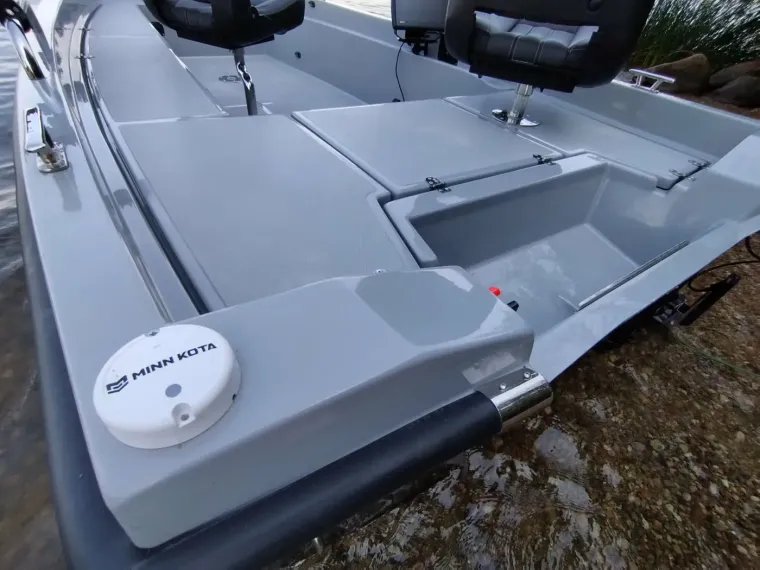
CE certificate on a boat: what design category C/D means
Category C: wind to force 6, waves to 2 m. D: force 4, 0.3 m. What the builder's plate shows, how to check CE on a used boat, what it means for the engine.
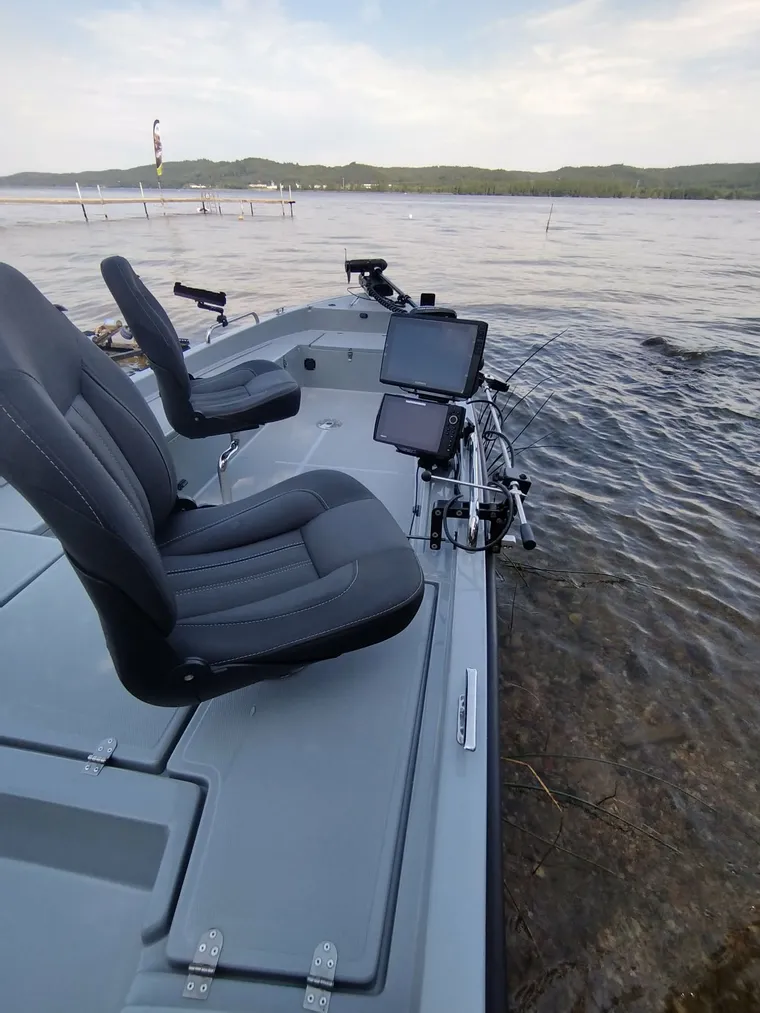
How much does a custom fishing boat cost? 2026 prices
Hawala 450 hull from PLN 13,000 net (≈ €2,950). What a ready-to-fish package with outboard, sonar, Minn Kota and trailer costs: 3 scenarios, real ranges.