6 min read
CE certificate on a boat: what design category C/D means
Category C: wind to force 6, waves to 2 m. D: force 4, 0.3 m. What the builder's plate shows, how to check CE on a used boat, what it means for the engine.
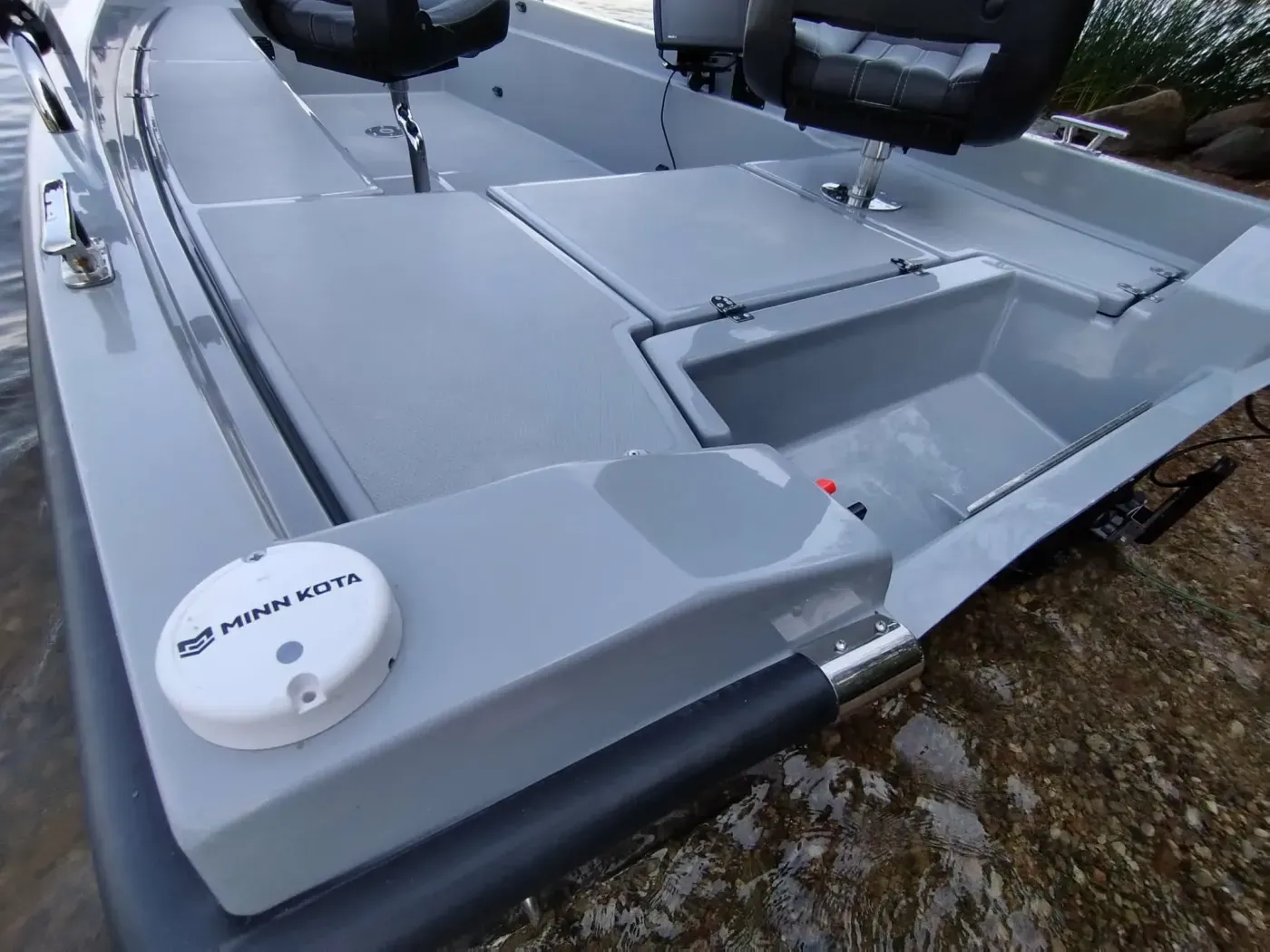
Design category C means a boat designed for winds up to Beaufort force 6 and significant wave heights up to 2 m; category D means winds up to force 4 and waves up to 0.3 m (occasionally 0.5 m). The Hawala 450 is CE marked with design category C/D for 4/5 persons: four aboard in rougher conditions, five on sheltered water. Below: what is on the plate, how to check CE on a used boat, what it means for the engine, and where UK buyers stand after Brexit.
What a CE certificate on a boat actually is
The CE marking on a boat is the manufacturer’s declaration that the craft meets the essential requirements of Directive 2013/53/EU on recreational craft. The directive has applied since 18 January 2016 and covers boats with a hull length from 2.5 m to 24 m, whatever the propulsion – so the Hawala 450 and 410 are both in scope.
Formally, “CE certificate” is three things:
- The CE marking on the builder’s plate.
- The EU declaration of conformity – a document signed by the manufacturer and handed over with the boat.
- The Watercraft Identification Number (WIN) – permanently marked on the hull, normally on the starboard side of the transom.
The design category comes from a stability and buoyancy assessment under ISO 12217 (Part 3 for boats under 6 m). The letter A, B, C or D states the conditions in which the boat is safe at its maximum load.
Design categories A, B, C and D – the table
The directive defines the categories by Beaufort wind force and significant wave height (H⅓). Example waters are indicative – the same lake can be “D” at dawn and “C” by mid-afternoon.
| Category | Wind | Significant wave height | Typical waters and conditions |
|---|---|---|---|
| A | above force 8 | above 4 m | Open ocean, long offshore passages |
| B | up to force 8 | up to 4 m | Open sea, well offshore |
| C | up to force 6 | up to 2 m | Coastal waters, estuaries, large bays, big lakes and lochs in a stiff breeze |
| D | up to force 4 | up to 0.3 m (occasionally 0.5 m) | Small and medium lakes, rivers, canals, sheltered inlets |
For an angler on inland water the bottom two rows matter. D covers most lakes and rivers in normal conditions. C is the margin for the days a big lake or loch gets a force 5–6 and waves on the windward shore reach a metre – which happens on long trolling sessions.
What “C/D” and “4/5 persons” mean on one plate
A single boat can carry two categories because each one is tied to a different load: more people and gear mean less freeboard and less stability.
Read C/D, 4/5 persons like this: in category C (up to force 6, 2 m waves) a maximum of 4 people; in category D (up to force 4, 0.3 m waves) a maximum of 5. Persons and maximum load in kilograms are two separate limits – whichever you hit first applies. Two anglers with batteries, a trolling motor and full tackle “weigh” about as much as three passengers.
What must be on the builder’s plate
Annex I, point 2.2 of the directive requires every boat to carry a permanently fixed plate with at least:
- the manufacturer’s name, trade mark and contact address,
- the CE marking,
- the design category (A, B, C or D),
- the manufacturer’s maximum recommended load, excluding fuel and water in fixed tanks,
- the recommended number of persons.
Most builders also add the maximum engine power. If it is not on the plate, it is in the owner’s manual, which comes with every CE-marked boat.
In practice: maximum load is the combined mass of people, gear, engine, batteries and portable fuel. Persons assumes the load is distributed as designed (seated, not standing on the gunwale). Maximum power is a ceiling; exceeding it voids the declaration of conformity and, usually, your insurance.
Why a boat without CE is a problem
A boat built after 2016 should not reach the EU market without CE marking. If it has, the risk moves to you:
- Registration. Where it applies, the declaration of conformity and the WIN identify the boat. Without them expect extra paperwork or a survey.
- Insurance. A hull insurer asks for the category and the maximum engine power, and checks at claim time whether you stayed within them.
- Resale. A boat without CE sells slower and cheaper; buyers in Germany and Scandinavia often will not discuss one at all.
- Safety. The category is a test of stability, freeboard and buoyancy. For boats under 6 m the directive requires the craft to stay afloat when flooded. The Hawala’s double-shell hull has a sealed buoyancy space between the two shells for exactly this.
A boat imported from outside the EU can be brought up to CE through a post-construction assessment (PCA module) by a notified body – price the cost and time in.
CE and UKCA after Brexit – where UK buyers stand
In Great Britain the Recreational Craft Regulations 2017 mirror the EU directive, and in August 2023 the UK government announced that CE marking will be recognised indefinitely for recreational craft, alongside UKCA. In Northern Ireland CE marking continues under EU rules. A CE-marked boat with a declaration of conformity can therefore be placed on the UK market without a separate UKCA assessment. Marking and import rules can change, so check current GOV.UK guidance before shipping a boat across the Channel.
How to check CE when buying a used boat
- Find the builder’s plate. Usually in the cockpit or on the transom; permanently fixed, legible, with all the items listed above.
- Find the WIN on the hull. Starboard side of the transom, moulded or stamped in: country code, manufacturer code, serial number, month and year of production, model year.
- Ask for the EU declaration of conformity. The WIN on the document must match the hull. No declaration on a 2016-or-later boat is a warning sign.
- Ask for the owner’s manual. That is where the maximum engine power and the load layout are.
- Compare the engine with the plate. An engine above the manufacturer’s rating means the boat has been run outside its declaration. Knock it off the price or walk away.
- Check the plate has not been “transferred”. New plate on old laminate, different manufacturer on WIN and plate, painted-over number – walk away.
What CE means when choosing an engine
The maximum power on the plate is a limit, not a target. A 4.5 m boat on a lake needs power matched to how you fish and to local rules, not the maximum.
Those rules differ by country. In Poland, where the Hawala is built, a fishing boat must be registered from 15 kW (about 20 hp) or 7.5 m, and a licence is needed above 10 kW; Germany draws its licence line at 11.03 kW (15 hp) on federal inland waterways. Country thresholds are in our FAQ. Confirm the rated power for your Hawala 450 on its plate and in the manual; when you order, we match the engine to the boat.
Frequently asked questions
Does the Hawala 450 have a CE certificate?
Yes. The Hawala 450 is CE marked with design category C/D: 4 persons in category C, 5 in category D. The boat comes with an EU declaration of conformity, a builder’s plate and a WIN on the hull.
Is category D enough for a big lake or a loch?
In normal conditions, yes. When a large lake gets a force 5–6, waves exceed 0.3 m and that is category C territory. The Hawala 450 carries both categories, so you keep fishing with a lighter load (4 persons instead of 5).
Can I fit a more powerful engine than the plate allows?
Not if you want to keep the declaration of conformity and your insurance cover. The maximum power comes from stability tests and transom strength; a bigger engine also raises the risk of a capsize in a sharp turn with a heavy stern.
Specifications and standard equipment are on the Hawala 450 page. Choose an engine, fish finder or trailer in the configurator – it builds a ready list to send us on WhatsApp or by e-mail.
How to Outfit a Fishing Boat: Motor, Sonar, Electrics
Order of investment, thrust and Ah ranges, screen sizes, night-light rules and beginner mistakes. Three builds: starter, sensible, full trolling.
How much does a custom fishing boat cost? 2026 prices
Hawala 450 hull from PLN 13,000 net (≈ €2,950). What a ready-to-fish package with outboard, sonar, Minn Kota and trailer costs: 3 scenarios, real ranges.